Current state of automated control systems for field artillery combat employment in condition diagnostics
Keywords:
Automated command and control systems, field artillery, fire control, tactical-level operations, information and communication infrastructure, multiple round simultaneous impactSynopsis
This chapter provides a comprehensive overview of automated artillery command and control systems (ACS) for field artillery at the tactical level, emphasizing their role in condition diagnostics and adaptive fire management. The theoretical foundations of information and control systems are analyzed, including mathematical modeling, algorithmization of military tasks, and integration of hardware-software components. International experience in the design and implementation of field artillery ACS, including systems such as TACFIRE (Tactical Fire Direction System) (USA), ADLER (Artillery Data, Location and Evaluation/Reconnaissance system) (Germany), and BATES (Battlefield Artillery Target Engagement System) (UK), is examined. Special attention is given to the structure, functionality, and performance metrics of ACS, highlighting the importance of real-time verification of the artillery firing cycle, Multiple Round Simultaneous Impact (MRSI), and “shoot and scoot” tactics. The chapter also discusses the principles of modern information and communication infrastructure, operational efficiency, and resilience of ACS under complex combat conditions, providing a methodological basis for future development of high-performance automated artillery systems.
References
Boltenkov, V., Brunetkin, O., Dobrynin, Y., Maksymova, O., Kuzmenko, V., Gultsov, P. et al. (2021). Devising a method for improving the efficiency of artillery shooting based on the Markov model. Eastern-European Journal of Enterprise Technologies, 6 (3 (114)), 6–17. https://doi.org/10.15587/1729-4061.2021.245854
Dobrynin, Y., Volkov, V., Maksymov, M., Boltenkov, V. (2020). Development of physical models for the formation of acoustic waves at artillery shots and study of the possibility of separate registration of waves of various types. Eastern-European Journal of Enterprise Technologies, 4 (5 (106)), 6–15. https://doi.org/10.15587/1729-4061.2020.209847
Dobrynin, Y., Brunetkin, O., Maksymov, M., Maksymov, О. (2020). Constructing a method for solving the riccati equations to describe objects parameters in an analytical form. Eastern-European Journal of Enterprise Technologies, 3 (4 (105)), 20–26. https://doi.org/10.15587/1729-4061.2020.205107
Brunetkin, O., Beglov, K., Brunetkin, V., Maksymov, О., Maksymova, O., Havaliukh, O. et al. (2020). Construction of a method for representing an approximation model of an object as a set of linear differential models. Eastern-European Journal of Enterprise Technologies, 6 (2 (108)), 66–73. https://doi.org/10.15587/1729-4061.2020.220326
Brunetkin, O., Maksymov, M., Brunetkin, V., Maksymov, О., Dobrynin, Y., Kuzmenko, V. et al. (2021). Development of the model and the method for determining the influence of the temperature of gunpowder gases in the gun barrel for explaining visualize of free carbon at shot. Eastern-European Journal of Enterprise Technologies, 4 (1 (112)), 41–53. https://doi.org/10.15587/1729-4061.2021.239150
Brunetkin, O., Maksymov, M., Dobrynin, Y., Demydenko, V., Sidelnykov, O. (2024). Development of a process model for determining the composition and energy characteristics of a pyrotechnic mixture using the library method. EUREKA: Physics and Engineering, 5, 99–112. https://doi.org/10.21303/2461-4262.2024.003453
Brunetkin, O., Dobrynin, Y., Maksymenko, A., Maksymova, O., Alyokhina, S. (2020). Inverse problem of the composition determination of combustion products for gaseous hydrocarbon fuel. Computational Thermal Sciences: An International Journal, 12 (6), 477–489. https://doi.org/10.1615/computthermalscien.2020034878
Maksymov, M. V., Brunetkin, O. I., Beglov, K. V., Alyokhina, S. V., Butenko, O. V. (2022). Automatic Control for the Slow Pyrolysis of Organic Materials with Variable Composition. Advanced Control Systems, 397–434. https://doi.org/10.1201/9781003337010-16
Brunetkin, A., Beglov, K., Maksimov, M. Ulitskaja, E. (2021). Model and method of controlled pyrolysis of organic sub-stances of variable composition. International Scientific Technical Journal “Problems of Control and Informatics”, 66 (1), 134–146. https://doi.org/10.34229/1028-0979-2021-1-12
Brunetkin, O., Sidelnykov, O., Maksymov, M., Dobrynin, Y. (2025). Improving the model for determining the composition of gunpowder gases during thermal destruction of gunpowder in a limited volume space. Eastern-European Journal of Enterprise Technologies, 3 (6 (135)), 35–45. https://doi.org/10.15587/1729-4061.2025.330654
Repilo, Y. I. (2014). Pohliady viiskovykh fakhivtsiv providnykh krain svitu na kontseptsiiu vohnevoho urazhennia protyvnyka v operatsiiakh. Materialy naukovo-praktychnoho seminaru kafedry raketnykh viisk i artylerii. Kyiv: NUOU, 30–40.
Vyshnevskyi, Y. V. (2014). Shchodo perspektyv stvorennia avtomatyzovanoi systemy zboru ta obrobky rozviduvalnykh vidomostei. Zbirnyk tez dopovidei naukovo-tekhnichnoi konferentsii “Perspektyvy rozvytku raketnykh viisk i artylerii Sukhoputnykh viisk”. Lviv: Akademiia Sukhoputnykh viisk. 40–42. Available at: https://asv.mil.gov.ua/content/nauka/2014/5-6-11-2014_mat_tez_dop.pdf
Zahorka, O. M., Kolesnykov, V. O., Koval, V. V., Zahorka, I. O. (2012). Do pytannia zastosuvannia rozviduvalno-udarnykh i rozviduvalno-vohnevykh kompleksiv u merezhetsentrychnii viini. Nauka i tekhnika Povitrianykh Syl Zbroinykh Syl Ukrainy, 3, 8–13. Available at: http://nbuv.gov.ua/UJRN/Nitps_2012_3_5
Zahorka, O. M., Koval, V. V., Tiurin, V. V., Maliuha, V. H., Zahorka, I. O. (2016). Osoblyvosti ta pryntsypy pobudovy merezhetsentrychnoi systemy upravlinnia uhrupovannia viisk (syl). Zbirnyk naukovykh prats Kharkivskoho universytetu Povitrianykh Syl. 3, 7–11. Available at: http://nbuv.gov.ua/UJRN/ZKhUPS_2016_3_4
Tkachuk, P. P., Budaretskyi, Y. I., Shchavinskyi, Y. V., Prokopenko, V. V. (2015). Vplyv zasobiv avtomatyzatsii upravlinnia pidrozdilamy i vohnem artylerii na efektyvnist yii zastosuvannia. Viiskovo-tekhnichnyi zbirnyk, 12, 75–82. Available at: http://nbuv.gov.ua/UJRN/vtzb_2015_12_16
Serhiienko, R. V., Didichenko, O. A. (2014). Dosvid zastosuvannia zasobiv artyleriiskoi rozvidky u kontrbatareinii borotbi. Zbirnyk tez dopovidei naukovo-tekhnichnoi konferentsii “Perspektyvy rozvytku raketnykh viisk i artylerii Sukhoputnykh viisk”. Lviv: Akademiia Sukhoputnykh viisk, 101–103. Available at: https://asv.mil.gov.ua/content/nauka/2014/5-6-11-2014_mat_tez_dop.pdf
Bieliaiev, M. I., Tolmachov, O. M. (2015). Monitorynh stanu samokhidnoi artylerii Sukhoputnykh viisk Zbroinykh Syl Ukrainy ta vyznachennia napriamkiv yii rozvytku. Viiskovo-tekhnichnyi zbirnyk, 3, 11–15. Available at: http://nbuv.gov.ua/UJRN/soivt_2015_3_5
Techniques for the Fires Brigade (2012). Washington: CreateSpace Independent Publishing Platform, 183. Available at: https://www.amazon.com/TechniquesPublication-3-09-24-3-09-22-November/dp/1481200356
Field Manual 2-0 Intelligence (2018). Washington: Department of the Army. Available at: https://irp.fas.org/doddir/army/fm2-0-2018.pdf
ADLER II Artillery Computer Network Delivered to Troops. Army Technology. Available at: https://www.army-technology.com/contractors/data/kulr-technology-partners-us-army/pressreleases/press15/
Field Manual 3-09 Field Artillery Operations and Fire Support (2014). Washington: Department of the Army, 4–12. Available at: https://www.scribd.com/document/248059115/FM-3-09-Field-Artillery-Operations-and-Fire-Support
Fomin, I. M. (2000). Teoretychni osnovy planuvannia artyleriiskoi rozvidky. VAU.
Gall, R. (2002). Enlightening the Artillery in the Army of the Future. Soldier and Technology, 13–18.
Downloads
Volume
Pages
8-30
Text Identifier of this Chapter
Chapter 1
Published
June 18, 2026
Copyright (c) 2026 Maksym Maksymov, Pavlo Gultsov, Oleksandr Toshev, Ruslan Riaboshapka

How to Cite
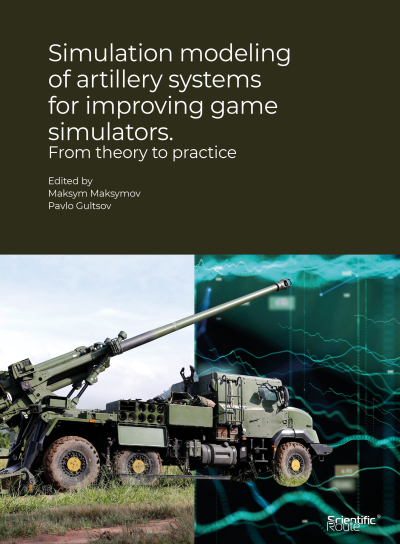
Maksymov, M., Gultsov, P., Toshev, O., & Riaboshapka, R. (2026). Current state of automated control systems for field artillery combat employment in condition diagnostics. In M. Maksymov, P. Gultsov, O. Toshev, O. Sidelnykov, R. Riaboshapka, O. Brunetkin, V. Davydov, V. Demydenko, M. Maksymov, O. Maksymova, Y. Dobrynin, O. Maksymov, & V. Boltenkov, Simulation modeling of artillery systems for improving game simulators. From theory to practice (pp. 8-30). Scientific Route OÜ®. https://doi.org/10.21303/978-9908-8450-1-2.ch1