Methods for rapid determination of the composition and condition of nitrocellulose propellants based on thermodynamic modeling
Keywords:
Nitrocellulose propellants, library method, rapid composition verification, inverse identification problems, Amagat’s law, Peng–Robinson equation of stateSynopsis
A method for rapid verification of the composition and energetic characteristics of nitrocellulose propellants is presented. It is based on a library approach to solving direct and inverse problems of thermal decomposition modeling. The library method forms a multidimensional array of solutions by varying elemental composition, enthalpy, and combustion conditions. This approach allows efficient determination of propellant composition from measurable parameters, primarily the temperature and combustion conditions of the reaction products, even in ill-conditioned inverse problems. An algorithm for encoding initial parameters and a procedure for successive data reduction ensure unambiguous reconstruction of the composition. Special attention is given to modeling combustion in closed volumes, selecting real-gas equations of state, accounting for pressure effects, chemical equilibrium, and possible formation of condensed phases. The results provide a theoretical and methodological basis for practical tools to rapidly assess propellant condition and refine internal ballistics parameters under limited information.
References
Boltenkov, V., Brunetkin, O., Dobrynin, Y., Maksymova, O., Kuzmenko, V., Gultsov, P. et al. (2021). Devising a method for improving the efficiency of artillery shooting based on the Markov model. Eastern-European Journal of Enterprise Technologies, 6 (3 (114)), 6–17. https://doi.org/10.15587/1729-4061.2021.245854
Dobrynin, Y., Volkov, V., Maksymov, M., Boltenkov, V. (2020). Development of physical models for the formation of acoustic waves at artillery shots and study of the possibility of separate registration of waves of various types. Eastern-European Journal of Enterprise Technologies, 4 (5 (106)), 6–15. https://doi.org/10.15587/1729-4061.2020.209847
Dobrynin, Y., Brunetkin, O., Maksymov, M., Maksymov, О. (2020). Constructing a method for solving the riccati equations to describe objects parameters in an analytical form. Eastern-European Journal of Enterprise Technologies, 3 (4 (105)), 20–26. https://doi.org/10.15587/1729-4061.2020.205107
Brunetkin, O., Beglov, K., Brunetkin, V., Maksymov, О., Maksymova, O., Havaliukh, O., Demydenko, V. (2020). Construction of a method for representing an approximation model of an object as a set of linear differential models. Eastern-European Journal of Enterprise Technologies, 6 (2 (108)), 66–73. https://doi.org/10.15587/1729-4061.2020.220326
Brunetkin, O., Maksymov, M., Brunetkin, V., Maksymov, О., Dobrynin, Y., Kuzmenko, V., Gultsov, P. (2021). Development of the model and the method for determining the influence of the temperature of gunpowder gases in the gun barrel for explaining visualize of free carbon at shot. Eastern-European Journal of Enterprise Technologies, 4 (1 (112)), 41–53. https://doi.org/10.15587/1729-4061.2021.239150
Brunetkin, O., Maksymov, M., Dobrynin, Y., Demydenko, V., Sidelnykov, O. (2024). Development of a process model for determining the composition and energy characteristics of a pyrotechnic mixture using the library method. EUREKA: Physics and Engineering, 5, 99–112. https://doi.org/10.21303/2461-4262.2024.003453
Brunetkin, O., Dobrynin, Y., Maksymenko, A., Maksymova, O., Alyokhina, S. (2020). Inverse problem of the composition determination of combustion products for gaseous hydrocarbon fuel. Computational Thermal Sciences: An International Journal, 12 (6), 477–489. https://doi.org/10.1615/computthermalscien.2020034878
Maksymov, M. V., Brunetkin, O. I., Beglov, K. V., Alyokhina, S. V., Butenko, O. V. (2022). Automatic Control for the Slow Pyrolysis of Organic Materials with Variable Composition. Advanced Control Systems. River Publishers, 397–434. https://doi.org/10.1201/9781003337010-16
Brunetkin, O., Beglov, K., Maksimov, M., Ulitskaja, E. (2023). Model and method of controlled pyrolysis of organic sub-stances of variable composition. International Scientific Technical Journal "Problems of Control and Informatics", 66 (1), 134–146. https://doi.org/10.34229/1028-0979-2021-1-12
Brunetkin, O., Sidelnykov, O., Maksymov, M., Dobrynin, Y. (2025). Improving the model for determining the composition of gunpowder gases during thermal destruction of gunpowder in a limited volume space. Eastern-European Journal of Enterprise Technologies, 3 (6 (135)), 35–45. https://doi.org/10.15587/1729-4061.2025.330654
Dobrynin, Y., Maksymov, M., Boltenkov, V. (2020). Development of a method for determining the wear of artillery barrels by acoustic fields of shots. Eastern-European Journal of Enterprise Technologies, 3 (5 (105)), 6–18. https://doi.org/10.15587/1729-4061.2020.206114
Dobrynin, Y. V., Boltenkov, V. O., Maksymov, M. V. (2020). Information technology for automated assessment of the artillery barrels wear based on SVM classifier. Applied Aspects of Information Technology, 3 (3), 117–132. https://doi.org/10.15276/aait.03.2020.1
Suykens, J. A. K., Van Gestel, T., De Brabanter, J., De Moor, B., Vandewalle, J. (2002). Least Squares Support Vector Machines. Singapore: World Scientific, 295.
Xia, X.-L., Jiao, W., Li, K., Irwin, G. (2013). A Novel Sparse Least Squares Support Vector Machines. Mathematical Problems in Engineering, 2013, 1–10. https://doi.org/10.1155/2013/602341
LS-SVMlab toolbox. Available at: https://www.esat.kuleuven.be/sista/lssvmlab/
James, G., Witten, D., Hastie, T., Tibshirani, R. (2013). Support Vector Machines. An Introduction to Statistical Learning. Springer Texts in Statistics, Vol. 103. New York: Springer, 337–372. https://doi.org/10.1007/978-1-4614-7138-7_9
Downloads
Volume
Pages
117-142
Text Identifier of this Chapter
Chapter 5
Published
June 19, 2026
Copyright (c) 2026 Olexander Brunetkin, Oksana Maksymova, Yevhenii Dobrynin, Oleksandr Sidelnykov

How to Cite
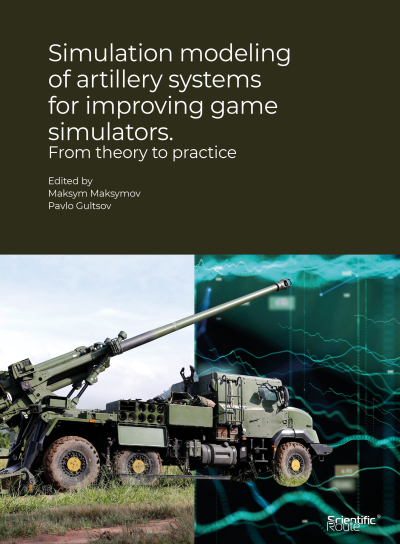
Brunetkin, O., Maksymova, O., Dobrynin, Y., & Sidelnykov, O. (2026). Methods for rapid determination of the composition and condition of nitrocellulose propellants based on thermodynamic modeling. In M. Maksymov, P. Gultsov, O. Toshev, O. Sidelnykov, R. Riaboshapka, O. Brunetkin, V. Davydov, V. Demydenko, M. Maksymov, O. Maksymova, Y. Dobrynin, O. Maksymov, & V. Boltenkov, Simulation modeling of artillery systems for improving game simulators. From theory to practice (pp. 117-142). Scientific Route OÜ®. https://doi.org/10.21303/978-9908-8450-1-2.ch5