PSYCHEDELIC-INSPIRED DRUGS COULD RELIEVE DEPRESSION WITHOUT CAUSING HALLUCINATIONS
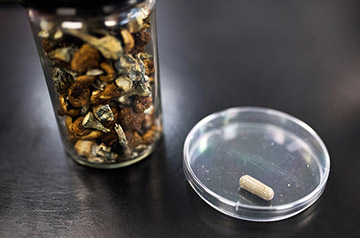
Psychedelic drugs, best known for causing hallucinations, can also lift users’ moods, preliminary results from clinical trials suggest. But the risks that come with the trip are an obstacle to using the drugs as antidepressants. Hallucinations might trigger psychosis in people with certain risk factors, and because of their unpredictable effects, clinicians have to closely monitor patients as they take the drugs.
Now, researchers think they may be able to take hallucinations out of the equation. LSD and psilocin—the psychedelic compound in magic mushrooms—can produce an antidepressant response in mice through a molecular mechanism that is completely separate from the one responsible for hallucinogenic effects, the team reports in a Nature Neuroscience paper today. The results, they say, pave the way to developing psychedelic-like drugs that could treat depression without hallucinations.
The work is rigorous and careful, says Revathy Chottekalapanda, a neuroscientist at Weill Cornell Medicine, and the results are intriguing. But Chottekalapanda and others emphasize that the path from demonstrating these kinds of effects in basic research to developing drugs that are effective in humans could be treacherous.
Research into the effects of psychedelics has focused heavily on the serotonin 2A receptor in the brain, because the drugs produce hallucinations by binding to this receptor. But psychedelics are “infamous for being superpromiscuous drugs” says Rafael Moliner, a neuroscience Ph.D. student at the University of Helsinki and lead author of the paper. “They interact with a lot of receptors.”
In a 2021 paper in Cell, Moliner and his colleagues had shown that classical antidepressants work by binding to the receptor for a signaling molecule called brain-derived neurotrophic factor (BDNF). When BDNF binds with this receptor, called TrkB, it sets off the cellular processes that drive neuroplasticity: the growth and reorganization of connections between brain cells. Antidepressant drugs bind to TrkB, the researchers found—not taking the role of BDNF, but giving its signaling process a helping hand and triggering neuroplasticity, thought to be an important part of the antidepressant response.
In the new study, the researchers show that psychedelic drugs have a similar mechanism. First, they demonstrated that LSD and psilocin bind to TrkB in cells in a dish—and do so 1000 times more strongly than classical antidepressants. They also found the drugs spurred rat and mouse neurons to develop an increased number of neural connections, indicating increased neuroplasticity.
These findings suggested that psychedelics might have an antidepressant effect by acting on TrkB, even without triggering the serotonin receptor. So the team gave mice LSD alongside a compound that blocks the drug from binding to the serotonin 2A receptor, to see whether this would reduce depressionlike behavior without inducing hallucinations. With humans, you can simply ask whether someone experienced hallucinations, “but with mice, it’s not that easy,” Moliner says.
His team took advantage of the fact that rodents on a hallucinogenic drug normally twitch their heads as if they are shaking off a fly. Mice given LSD along with the serotonin 2A blocker did not display the head-twitch response. But they did show an improvement in the “freezing” behavior that researchers use as an analog of human depression, suggesting the drugs were still having an antidepressant effect.
These results may prompt more interest in finding drugs that exclusively target TrkB, says Gabriel Jacobs, a clinical pharmacologist at Leiden University, and in investigating whether hallucinations are necessary for psychedelics’ therapeutic effects in humans.
Others warn that animal studies of depression often do not translate well to humans, and that the promise of psychedelics in clinical trials is not clear-cut. “Hundreds of papers” have found promising mechanisms for antidepressant treatment in mice, “none of which made it to the development of new pharmacological drugs that do better than gold-standard treatments for depression,” says Eiko Fried, a clinical psychologist at Leiden. And although psychedelics do really seem to help patients feel better, it’s not possible to conceal from patients whether they have taken a psychedelic or placebo, says Balázs Szigeti, a psychedelics researcher at Imperial College London. This muddies the evidence from clinical trials.
Senior author Eero Castrén, a neuroscientist at Helsinki, believes his team’s work may open up promising pathways for psychedelic-inspired antidepressants. But, “This will be quite a long journey,” Castrén says. Even if such drugs seemed effective in animals, extensive human tests would be needed to confirm that revamped psychedelics both relieve depression and are not hallucinogenic. “It’s not something that is going to happen in the next 5 years.”