EMBATTLED PHYSICIST FILES PATENT FOR UNPRECEDENTED AMBIENT SUPERCONDUCTOR
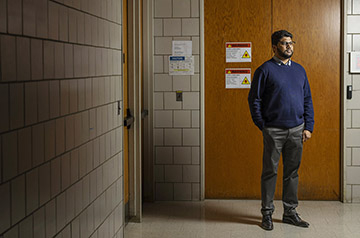
Ranga Dias, a physicist at the University of Rochester, has drawn headlines and controversy for his claims of concocting materials that superconduct at room temperature—despite the limitation that they would require extreme pressures to work. His latest creation would be by far his most sensational yet—although he has not sought any attention for it. In a little-noticed patent filing, Dias claims to have made a material that superconducts not only at room temperature, but also ambient pressure.
If true, the discovery would be profound, igniting a host of applications, such as transmission lines that conduct electricity without losses, hyperefficient computer chips, and cheaper levitating trains. “We cannot even imagine how impactful it would be,” says Eva Zurek, a superconductivity theorist at the University at Buffalo. Such a material would also force a major rethink of the physics at play, as current theories cannot account for superconductivity under fully ambient conditions.
But scientists who have been critical of Dias’s data and methods in his previous claims don’t believe his latest work either. “I’m highly skeptical,” says James Hamlin, a superconductivity researcher at the University of Florida, who believes any superconducting behavior reported in the patent filing could be the result of broken electrical contacts in the devices used to characterize the material. Mikhail Eremets, a high-pressure superconductivity expert at the Max Planck Institute for Chemistry, says his team has reviewed the patent but he does not trust its claim.
No paper or preprint on the new material has been published. The international patent application, which was filed in July 2022, only became public in April, and it has not been adjudicated. It typically takes about 2 years for a patent review to be completed. In 2020, Dias co-founded a company called Unearthly Materials to commercialize room-temperature superconductors.
The annual market for superconducting materials has already reached $1.1 billion, according to research firm MarketsandMarkets. Most of that money goes to low-temperature superconductors that are used in powerful magnets, such as those in MRI machines. Much of the rest is for so-called high-temperature superconductors commonly used for making lossless electrical transmission wires. But even high-temperature superconductors must be chilled by liquid nitrogen to 77 kelvins, requiring bulky and expensive cooling systems.
Dias first raised the prospect of doing away with that cooling demand with a 2020 report in Nature claiming that a mix of carbon, sulfur, and hydrogen (CSH) superconducts at 250 K (–23°C) when squeezed under pressures approaching those at the center of Earth. But following persistent complaints about the study’s measurements of the material’s magnetism, one of the key superconducting criteria, the paper was retracted last year by Nature over objections of all the authors. Dias has faced further heat over accusations he plagiarized material in his Ph.D. thesis.
Dias upped the ante in March with another report in Nature that a mixture of lutetium, nitrogen, and hydrogen (LNH) superconducts at 294 K (21°C) when compressed to about 3000 times atmospheric pressure. That’s vastly less pressure than CSH required. But it’s still 7.5 times the pressure experienced at the site of the sunken Titanic, 3800 meters below the ocean surface.
Now, Dias’s patent application suggests another form of LNH can superconduct without any added pressure at all. “The extremely low temperature and/or high-pressure requirements of previous superconductive materials placed significant obstacles on their use in most practical applications,” the patent states. “However, the presently disclosed material leaps past those obstacles and provides the first known room temperature, room pressure superconductor.”
The patent application describes methods for making multiple versions of LNH by varying temperatures, pressures, the amount of hydrogen and nitrogen, and reaction time. The application doesn’t provide the exact conditions that lead to an ambient pressure, room temperature superconductor, or what its precise atomic structure is. Hamlin says he’s concerned that experimental measurements included in the patent look like those in the March Nature paper, even though the patent and paper describe different synthesis procedures. But Russell Hemley, a materials chemist at the University of Illinois Chicago, says it’s not uncommon for different recipes to produce a material with the same structure.
Hemley has been one of the few independent researchers to replicate any of the superconductivity results from Dias’s group. Using a sample provided by the Rochester group, a team led by Hemley came close to matching one of Dias’s main claims for the high-pressure version of LNH, according to a preprint posted on arXiv on 9 June. Other groups, however, have followed Dias’s recipes for creating the material and have failed to see any signs of superconductivity.
The Illinois team found that electrical resistivity in the material drops sharply to near zero at a temperature 18°C below the maximum reported by Dias. Zurek notes that this electrical behavior is consistent with superconductivity, but not proof. The preprint did not report on whether the material can repel a magnetic field, a phenomenon that is considered a telltale signature of superconductivity. Those experiments are challenging, because like the electrical measurements, they must be done inside a tabletop pressure chamber, known as a diamond anvil cell.
If Dias’s latest patent claim holds up, however, confirming electrical and magnetic measurements could become far simpler, because they would presumably no longer need to be done within a diamond anvil cell. It would also be far easier to perform x-ray crystallography, which can be used to determine the material’s precise atomic arrangement.
Theorists have been struggling to explain LNH’s behavior with the conventional theory of superconductivity, which posits that vibrations in a material’s atomic lattice cause electrons to pair up, allowing them to surf through the material without resistance. In order to trigger this pairing, hydrogen-rich superconductors must still be cooled well below room temperature or be highly pressurized, or both, recent theoretical results suggest.
But Hemley and colleagues, in a preprint posted on 29 May, say LNH might provide an exception. They describe the theoretical electronic behavior for several LNH crystal structures and find that in one configuration the hydrogen atoms might form a “metallic network” strengthening the link between lattice vibrations and electron pairing, thereby allowing them to superconduct at near ambient conditions.
Zurek notes that this modeling study does not experimentally prove that any specific LNH structure superconducts at ambient conditions. However, she adds, “The work has inspired me to take a closer look.”